Retail floors, treatment rooms, hospitality shifts, school pick-ups and long commutes all ask the same thing of the body: stay upright, stay useful, keep going. By evening, the shoes come off—but the soles, ankles and calves can still feel as though they are carrying the day.
That sensation is not a sign that you need to attack your feet with more force. It is often a cue to change state: unload, move, breathe and then introduce slow, controlled touch.
A useful ritual can create a repeatable boundary between the demands of the day and the part of the evening that belongs to you.
What prolonged-standing research actually tells us
Standing is not inherently bad. Remaining in any static posture for too long is the more important issue. Safe Work Australia advises that workers should not remain seated, standing or static for prolonged periods, and recommends varying posture and movement. For standing tasks, it also points to practical supports such as a seat or stool, a full-foot footrest and suitable cushioning on hard floors.
A 2017 systematic review pooled 25 laboratory studies involving 591 participants. It found a consistent relationship between uninterrupted standing and the development of low-back and lower-extremity symptoms. The pooled estimate for a clinically relevant low-back symptom level was 71 minutes, or 42 minutes among participants classified as pain developers. Those figures are not a personal timer; they show how differently bodies may respond and why regular variation matters.

A separate occupational-standing experiment followed 12 people through three hours of simulated work. Researchers measured them every 30 minutes and reported rising discomfort across the low back and all lower-extremity regions, alongside changes in calf circumference and plantar-pressure distribution. Footwear affected some measures, but individual preferences varied.
The useful takeaway is beautifully simple: do not wait for the end of the day to change position. Move during the day—and give yourself a deliberate transition afterwards.
The movement-first rule
Massage can feel inviting when your feet are tired, but the first step should be movement. A few ankle pumps, toe spreads or a short walk changes the task your tissues are performing. It also helps you notice whether the sensation is ordinary end-of-day fatigue or something that deserves professional attention.
In a small 2024 randomised trial, 26 healthy older adults received either 15 minutes of Thai foot massage or 15 minutes of bed rest. The massage group showed immediate changes in several measured physiological and stress-related outcomes. The study used a manual Thai massage protocol rather than a wooden tool, so it is best read as early support for interest in slow tactile routines—not as a product test.
TRADITIONAL PERSPECTIVE
Technique before force
Traditional Chinese Medicine understands the feet as an important meeting place for channels travelling through the legs and body. Measured pressure and directional movement are used to encourage awareness and flow. This is a traditional framework, distinct from modern clinical evidence, but both perspectives favour technique over force.
Your five-minute shoes-off reset
Sit somewhere stable, with your back supported and one foot comfortably accessible. The sensation should remain pleasant or comfortably tender—not sharp, burning or numb. Work around, rather than directly over, irritated skin, prominent veins, new swelling or an injury.

Change the signal
Place both feet on the floor. Slowly lift and lower the heels five times, then the toes five times. Circle each ankle in both directions. Let your jaw soften as you exhale.
Warm the sole
Use the heel of your hand or a broad, smooth surface to make unhurried passes from the heel towards the ball of the foot. Think “wake up the surface”, not “dig into the problem”.
Trace the arch slowly
Follow the softer line of the arch with a rounded contact point. Move in short, controlled passes. If one area feels sensitive, reduce pressure and slow down instead of pressing harder.

Give the heel a broad pause
Use a flatter contact surface to hold gentle pressure around the fleshy heel pad. Pause for one comfortable breath, release fully, then repeat in two or three nearby positions.
Move upwards through the calf
With your hand—or the rounded edge of a suitable self-massage tool—make two or three light upward passes through the fleshy part of each calf. Avoid the shin bone, back of the knee and visible or tender veins.
Recheck, do not chase
Stand slowly and take a few steps. Notice temperature, contact with the floor and whether one side feels different. The goal is not to erase every sensation, but to finish with more awareness and less urgency.

WHEN A TOOL EARNS ITS PLACE

Three contact styles. One grounded ritual.
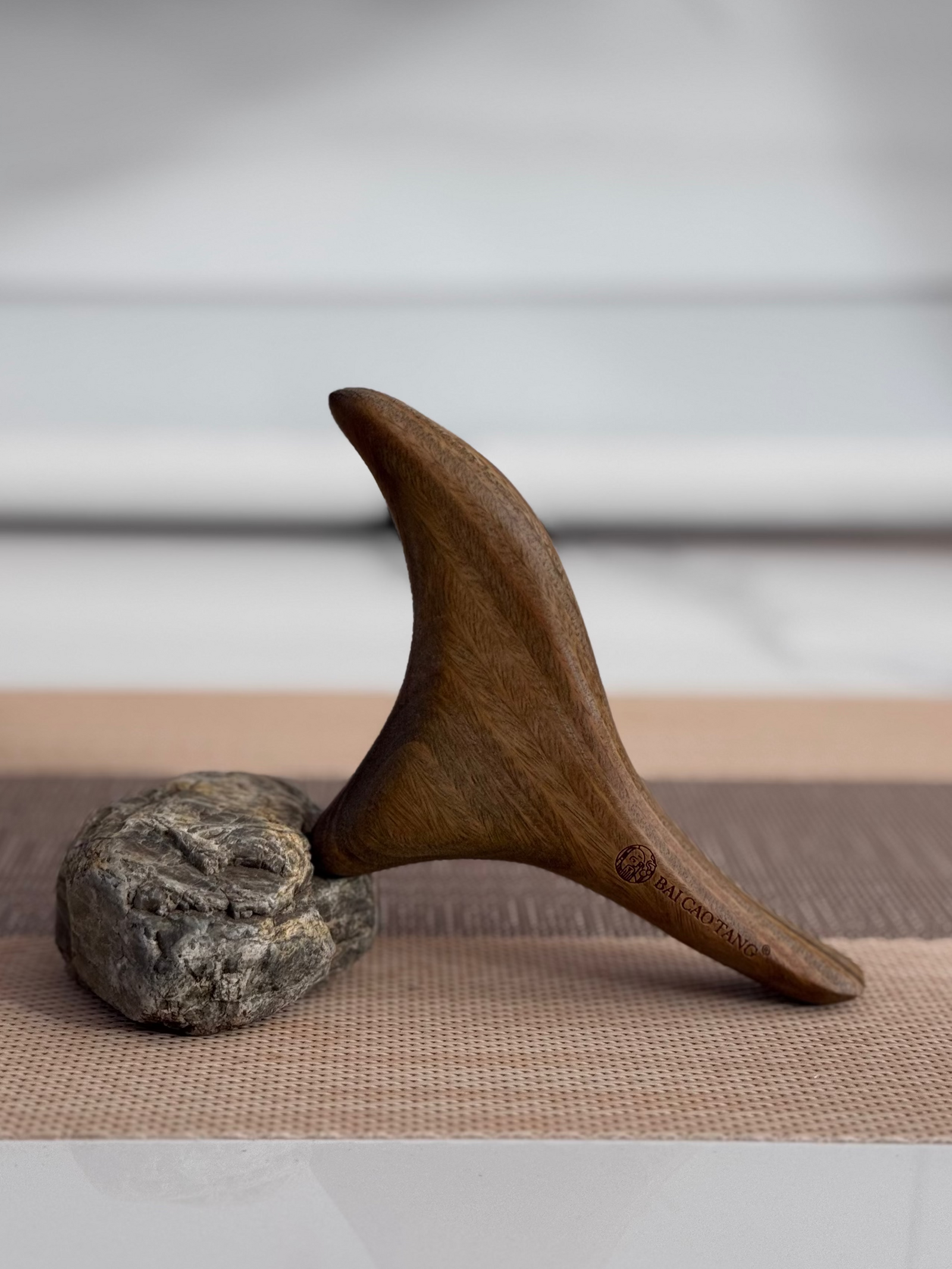
Hands are intuitive, but they can tire. A well-shaped tool offers different contact areas while keeping the movement measured. Bai Cao Tang’s compact Tri-Point form is carved from solid South American Green Sandalwood and hand-polished without lacquer or synthetic coating.


MELBOURNE CLINIC ROOTS
A ritual designed for real life
Bai Cao Tang Wellness grew from the philosophy of a Melbourne Traditional Chinese Medicine clinic: technique matters, pressure should be intentional, and daily care works best when it fits ordinary life.
The tool follows the ritual—not the other way around. Move first. Use controlled contact. Let comfort guide the pressure. For people who stand much of the day, the bigger picture still includes sensible footwear, posture variation, movement breaks and an appropriate work setup. The five-minute ritual is the evening layer: a calm signal that your shift is finished.
FAQ
Should I massage my feet immediately after work?
Begin with a brief change of position and gentle ankle movement, then use comfortable touch. If your feet are hot or visibly swollen, elevate them and seek advice if the change is unusual, persistent or one-sided.
How hard should I press?
Use less pressure than you think you need. Your toes should stay relaxed and you should be able to breathe normally. Sharp, electric, burning or numb sensations are cues to stop.
Can I use the pointed end everywhere?
No. A smaller contact point concentrates pressure. Reserve it for brief, controlled contact on fleshy areas and avoid bones, joints, broken skin, the back of the knee and prominent veins.
Is this reflexology or a clinical TCM treatment?
No. This is a general external self-massage ritual. Reflexology, acupuncture and personalised TCM treatment use distinct assessment and technique.
When should I skip self-massage?
Avoid an acute injury, broken or infected skin, suspected clot, unexplained swelling, reduced sensation or any area your health professional has advised you not to touch. Seek prompt advice for sudden one-sided swelling, warmth, redness, breathlessness or significant pain.
BEGIN YOUR EVENING FOOT RITUAL
Turn the pause into something you will want to repeat.
Three contact styles. Solid South American Green Sandalwood. One grounded five-minute transition.
EXPLORE THE TRI-POINT MASSAGERReferences
- Safe Work Australia. Sitting and standing. Accessed 22 July 2026.
- Coenen P, Parry S, Willenberg L, et al. Associations of prolonged standing with musculoskeletal symptoms—A systematic review of laboratory studies. Gait & Posture. 2017;58:310–318.
- Anderson J, Nester C, Williams A. Prolonged occupational standing: the impact of time and footwear. Footwear Science. 2018;10(3):189–201.
- Waters TR, Dick RB. Evidence of health risks associated with prolonged standing at work and intervention effectiveness. Rehabilitation Nursing. 2015;40(3):148–165.
- Thadanatthaphak Y, Kanpittaya J, Takong W, Chanaboon S, Tudpor K. Immediate effects of Thai foot massage on renal blood flow, psychological stress, and heart rate variability in community-dwelling older adults: a randomized controlled trial. F1000Research. 2024;13:838.
- World Health Organization. WHO International Standard Terminologies on Traditional Medicine in the Western Pacific Region. 2007.
- Kim SH, et al. Anatomical exploration of the KI1 acupoint: implications for medial and lateral plantar nerve stimulation. 2024.
Evidence note: The standing thresholds are pooled estimates, not personal cut-offs. The massage trial used a manual Thai foot-massage protocol in healthy older adults and did not test a Bai Cao Tang product. This article provides general information and does not replace individual medical or workplace advice.