If your brush regularly stalls halfway through a section, the next instinct is often to pull harder. That single moment—not brushing itself—is where a polished hair-care ritual can become unnecessary friction.
Mechanical breakage happens along the visible hair fibre. It is different from shedding at the follicle, yet over time it can leave the lengths looking rougher, the ends appearing less full and the brush collecting more short fragments than you would like.
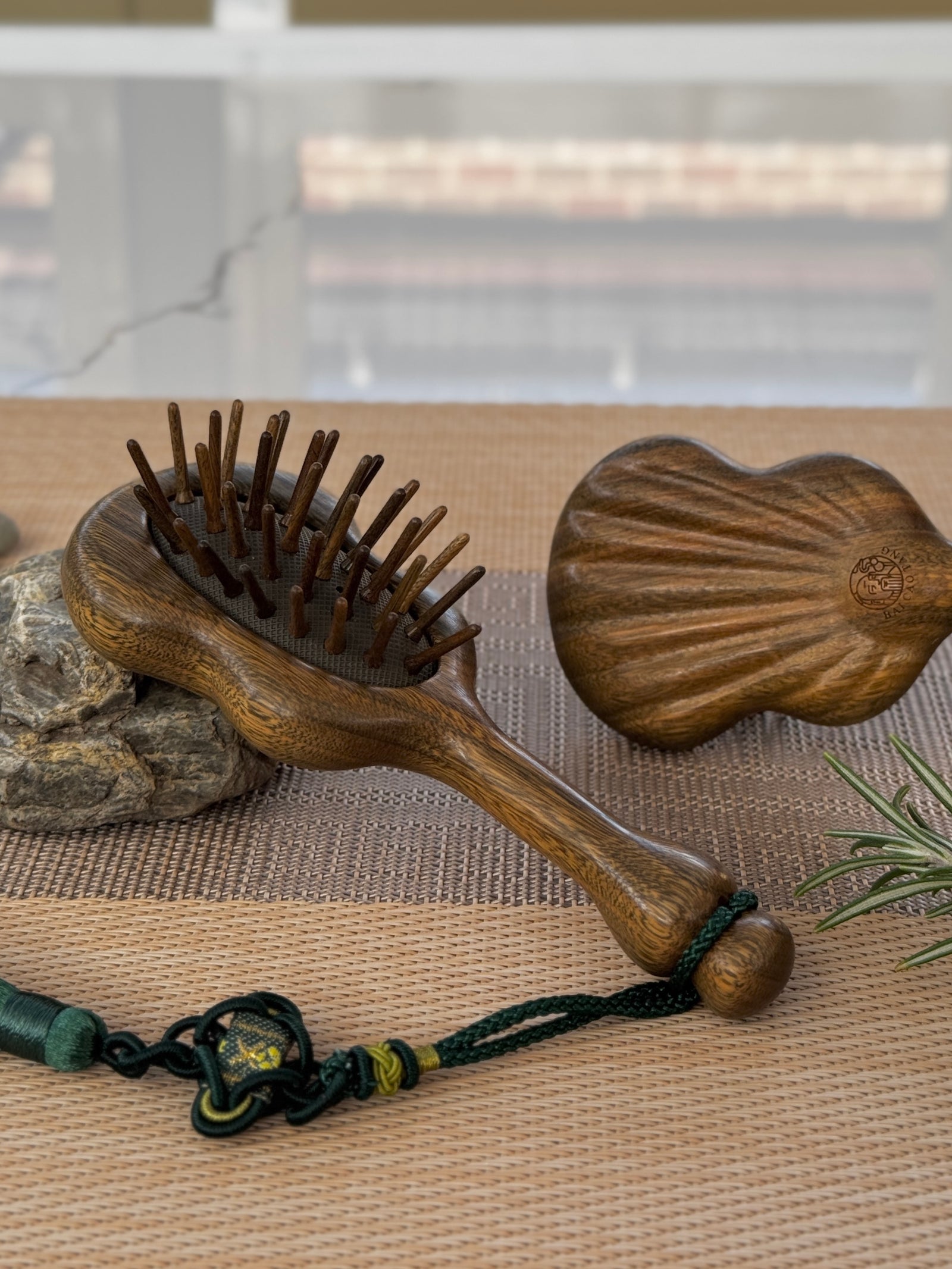
The Bai Cao Tang Portable Sandalwood Cushion Scalp Brush is designed to make a slower technique feel intuitive: flexible rounded wood pins sit in a spring-cushion base, while the compact handle gives the hand control without inviting force. The goal is simple—meet resistance with a change of technique, not more tension.
WHY THE ENDS CAN LOOK LESS FULL
Breakage changes the fibre.
Technique changes the ritual.
A 2018 study combined a questionnaire of 231 women, videos of 10 consumers and laboratory hair-tress testing. Everyday stroke counts were modest, but the laboratory work showed that hair condition, wetness and conditioning could substantially change the probability of a fibre experiencing a measured load event during combing.
What the fibre is telling you
- Friction matters: a snag concentrates load on fewer fibres.
- Wet hair needs context: straight or wavy hair is generally more vulnerable when handled wet, while tightly curled or textured hair may be easier to detangle wet with conditioner.
- Previously lightened hair needs extra care: laboratory bleached tresses showed the strongest wet-combing load signal.
- Slip can change the task: conditioner sharply lowered that laboratory signal in the bleached tresses.

READ THE CHART CORRECTLY
A signal about resistance,
not a promise about your hair.
The chart redraws the reported probability of a single fibre experiencing a load event of at least 1 gram in specific wet-combing laboratory conditions. Wet virgin Asian hair registered 10%, wet virgin Caucasian hair 47%, and wet bleached hair 100%. When conditioner was added to the wet bleached tress, the reported probability fell below 10%.
These values are not consumer breakage percentages and they do not compare brushes. They reveal something more useful for daily care: the condition of the hair and the amount of slip can transform how much resistance a fibre meets.

THE BAI CAO TANG DETANGLING RITUAL
Start at the ends.
Finish in flow.
Use the cushion brush as a feedback tool. Its spring base should move with the section; it should never become permission to pull through a knot.
Choose the right moment
For straight or wavy hair, allow the lengths to become mostly dry before brushing. For tightly curled or textured hair, detangle in sections while damp or wet with generous conditioner, following the method that keeps your curl pattern comfortable.
Support the section
Divide the hair into manageable sections. Hold each section above the area being brushed so the tug is not transferred directly to the scalp.
Release the ends first
Place the rounded wooden pins into the last few centimetres and use short, unhurried strokes. Once the ends move freely, begin slightly higher and repeat.
Progress upward
Work toward the mid-lengths and then the roots. If the brush stops, withdraw it, reduce the section and approach the tangle from below.
Complete at the scalp
When the lengths are clear, let the flexible pins and spring cushion follow the scalp contours in slow front-to-back pathways. Keep the contact comfortable and the rhythm calm.
Make it portable
Return the brush to its linen pouch and keep it in your bag or at your vanity. A tool within reach makes it easier to choose a composed reset instead of a rushed rescue.

DESIGNED FOR A LIGHTER HAND
Flexible pins.
A cushioned response.
The difference is not a decorative detail. The brush combines hand-polished South American Green Sandalwood with a spring-cushion base so the pins can respond to the contours beneath them. That movement gives the hand immediate feedback and encourages a measured pace.
The design advantage
- Rounded wooden pins: smooth contact through the lengths and across the scalp.
- Spring-cushion base: a responsive surface rather than a rigid bed of pins.
- Compact handle: close control when working in small sections.
- Solid Green Sandalwood body: hand-polished, naturally dense and individually grained.
- Linen pouch and tassel: a considered travel companion for daily upkeep.

ROOTED
MELBOURNE CLINICAL ROOTS
Professional thinking begins with the right distinction.
At Bai Cao Tang Wellness, our Melbourne Chinese medicine clinic background teaches us not to collapse every hair concern into the same story. Fibre breakage, visible shedding and changes at the scalp are not interchangeable.
A beautiful brushing ritual can help you handle the lengths with greater care. If you notice sudden or patchy loss, scalp inflammation, pain, scarring, or a persistent increase in shedding, arrange an assessment with a GP, dermatologist or appropriately qualified practitioner rather than relying on a grooming tool.
YOUR QUESTIONS, ANSWERED
Should I brush wet hair or dry hair?
For straight and wavy hair, the American Academy of Dermatology advises handling wet hair as little as possible because it breaks more easily when brushed or combed. Tightly curled or textured hair is an important exception: brushing while wet can reduce breakage when there is enough conditioner and the hair is divided into sections.
Why begin at the ends?
Starting at the ends lets you release a small tangle before it joins the resistance above it. Once the ends move freely, you can work upward in controlled stages.
What makes a cushion brush different from a rigid brush?
The flexible pins sit in a spring base that responds as the brush meets the contours of the head. In the Bai Cao Tang design, that cushioned movement works with a compact handle to give the hand feedback and close control while brushing in sections.
Can I use it on bleached or colour-treated hair?
Yes, with an especially conservative technique: add appropriate slip, use smaller sections, begin at the ends and stop at resistance. Chemically lightened fibres can be more vulnerable to grooming damage.
How do I care for the wooden brush?
Remove loose hair after use and wipe the wood with a soft dry cloth. Do not soak or rinse it. Store it in a cool, dry place away from prolonged heat, humidity and direct sunlight.
BEGIN YOUR GENTLER BRUSHING RITUAL
Less pulling.
More intention.
Bring a spring-cushion response, flexible rounded pins and the natural grain of South American Green Sandalwood to the moment your hair meets resistance.