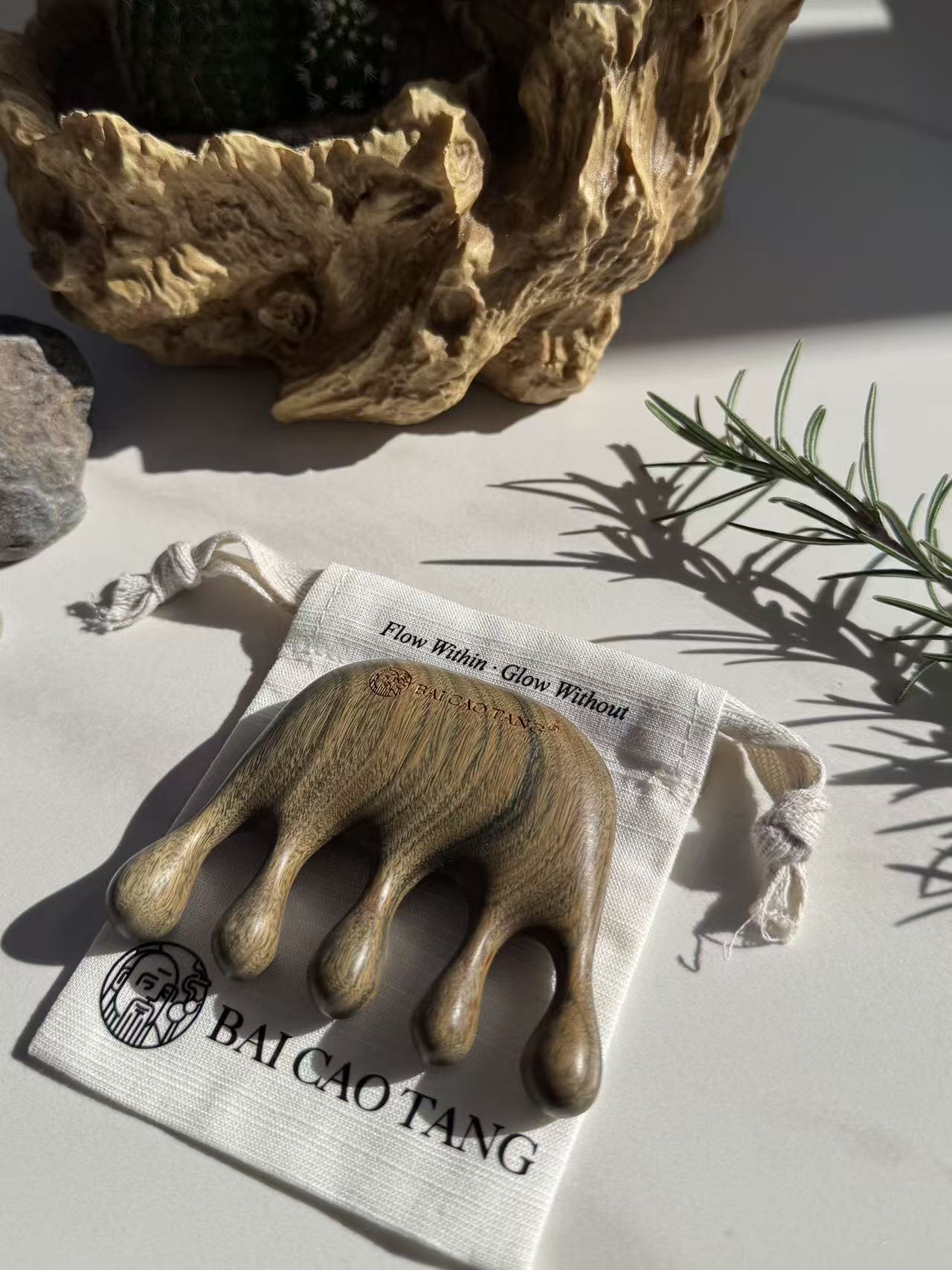
If two genuine wooden tools do not look exactly alike, that is not a flaw. It is the first sign that the material has a history of its own.
Natural grain turns, tone varies, and an unlacquered surface responds to handling and environment differently from moulded plastic or printed imitation wood. For Bai Cao Tang, this individuality is part of the luxury: a wellness object designed to become more personal—not remain factory-identical forever.

SOUTH AMERICAN GREEN SANDALWOOD
One material.
Many natural expressions.
Bai Cao Tang identifies its current wooden wellness collection as solid South American Green Sandalwood, traditionally named Bulnesia arborea. Current botanical databases accept Plectrocarpa arborea as the scientific name and list Bulnesia arborea as a synonym. The species is native from Colombia to Venezuela.
That identity should never be judged from colour alone. A genuine piece may appear golden-brown, olive-toned or deeper in colour depending on its grain, lighting, age and surface condition. The important constants are verified source, solid construction, authentic form and careful finish—not one colour swatch every piece must imitate.
WOOD IS A RESPONSIVE MATERIAL
Three realities
behind every individual piece.
The U.S. Forest Service Wood Handbook describes wood as a natural, hygroscopic material: it exchanges moisture with the surrounding air, and its structure and moisture relationships influence how it behaves. Wood also contains extractives that can affect colour, odour and surface properties. These are general wood-science principles—not a laboratory test of a Bai Cao Tang tool.
What you may notice
- Grain direction and tone differ between individual pieces
- Repeated wetting and rapid drying can stress unfinished wood
- Prolonged heat and direct sun can accelerate unwanted change
- Handling may gradually alter lustre and surface character
CARE LOGIC
LessWater, heat and forced change
A qualitative care guide based on general solid-wood moisture principles.
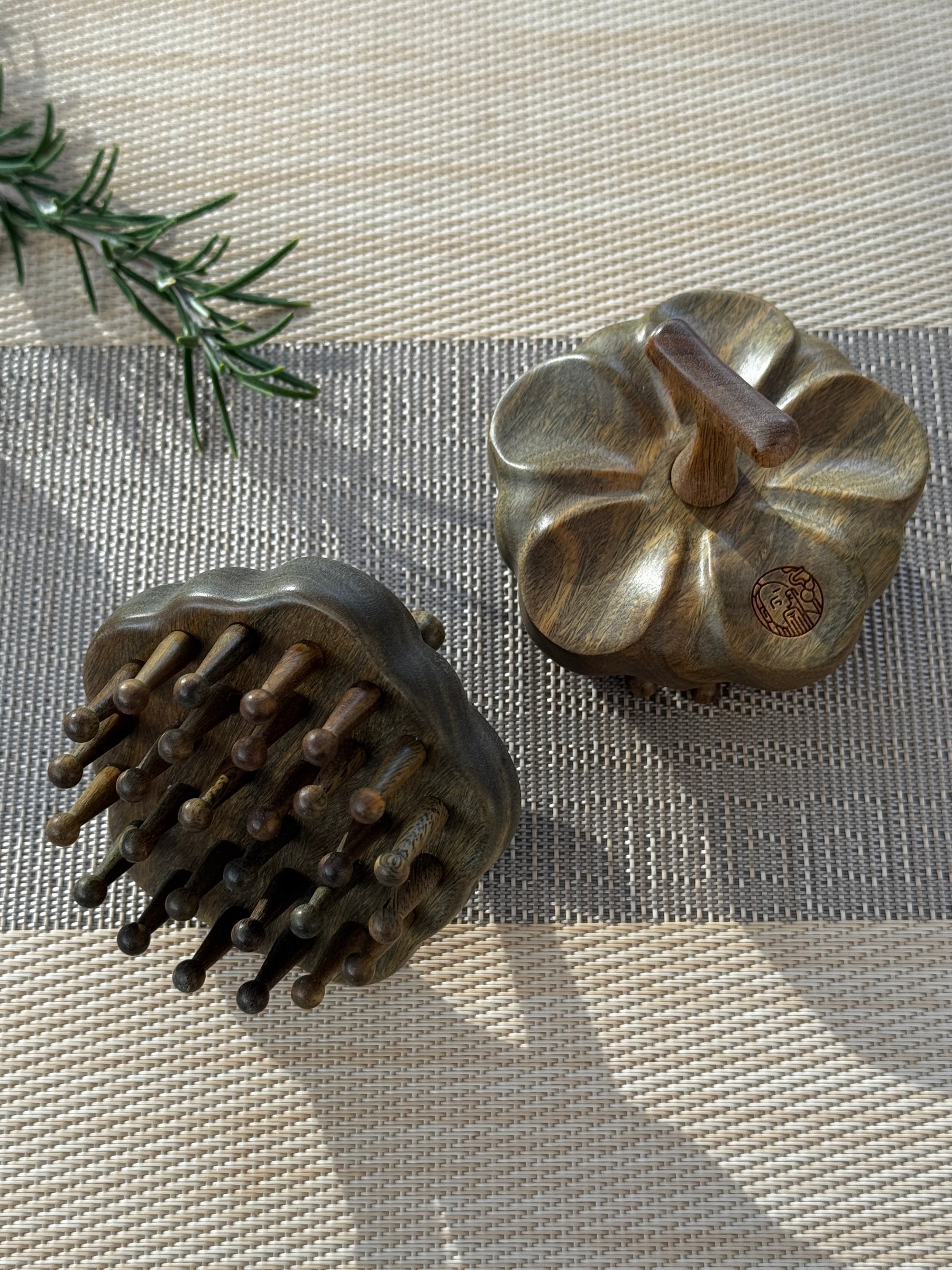
WHEN THE SURFACE LOOKS HAZY
A pale bloom is not
automatically damage.
A light haze or fine, crystalline-looking deposit can sometimes appear on the surface of dense, extractive-rich natural wood. Because wood contains naturally occurring extractives, a dry surface change may be part of the material’s evolving character. Appearance alone, however, cannot confirm exactly what a deposit contains.
A GENTLE FIRST RESPONSE
Dry, light and localised
Wipe the surface gently with a clean, soft, dry cloth. Keep the tool dry and ventilated, and observe whether the appearance settles without aggressive cleaning.
WHEN TO PAUSE
Damp, fuzzy or musty
Stop using the tool if a patch is fuzzy, spreading, damp, strongly musty or repeatedly returns with moisture. Keep it separate and contact Bai Cao Tang for product-specific guidance.
THE FIVE-STEP CARE RITUAL
Clean gently.
Store thoughtfully.
Care should preserve the real object, not polish away the character that makes it yours.
Wipe promptly
After use, remove skincare residue with a soft cloth. If a lightly damp cloth is required, use minimal moisture.
Never soak
Do not leave an unlacquered wooden tool submerged or rinse it for an extended period.
Dry completely
Allow the surface to dry fully in a ventilated indoor place before returning it to a pouch or box.
Avoid extremes
Keep it away from prolonged direct sunlight, heaters, hot cars and very humid storage.
Store with space to breathe
Use the linen pouch supplied where applicable, and store in a clean, dry environment.
LED
CLINIC-INFORMED DESIGN
Chosen to be used, not merely displayed.
Bai Cao Tang Wellness brings a Melbourne clinical perspective to everyday ritual tools. Material, hand feel and controllable form matter because a beautiful object earns its place when it is easy to return to—and cared for well enough to remain part of the ritual.
FREQUENTLY ASKED QUESTIONS
Why is my piece not the same colour as the website photograph?
Lighting, screen display, grain direction, age and natural material variation can all affect appearance. A different tone alone does not establish that a piece is incorrect.
What should I do if I see a pale haze or crystal-looking layer?
Start with a clean, soft, dry cloth and keep the tool in a dry, ventilated place. Do not use harsh cleaner or oil to force the surface back to a particular appearance. If the area is fuzzy, spreading, damp or musty, stop using the tool and contact Bai Cao Tang for guidance.
Should I wash it under running water?
Avoid soaking or prolonged rinsing. Follow the current care instructions supplied with your specific tool; use the least moisture necessary and dry completely.
Can I leave it in the bathroom?
A consistently humid bathroom is not ideal storage for unfinished solid wood. A clean, dry indoor location is preferable.
Can I use oil?
Do not improvise. Use only a care method specifically recommended for your product, because oils and skincare ingredients can change appearance.
Does darker or greener always mean better quality?
No. Colour alone is not a reliable quality or authenticity test. Source, construction, finish and product documentation matter more.
Real material. Individual grain. Care that respects both.
SOURCES & MATERIAL NOTES
General wood behaviour: U.S. Forest Service, Wood Handbook and its chapter on moisture relations. Botanical naming and native range: Kew Plants of the World Online; synonym record: World Flora Online. Background on wood extractives: Forests (2024) review.
This article provides general material-care information. It does not identify a surface deposit from a photograph or replace the current care instructions supplied with a specific product.