The shower is finished, the towel is on—and one small knot turns brushing into a negotiation. A snag is resistance, not an instruction to add more force.
A calmer order begins somewhere less dramatic: choose the right moment for your hair texture, divide the hair, clear the ends and only then move upward. That sequence cannot repair an already damaged fibre, but it can make daily grooming more measured and easier to repeat.
Wet hair is not a one-rule category
Hair fibres change when they are wet, but “never detangle wet hair” is too simple. Texture matters.
The American Academy of Dermatology advises using conditioner after washing because it moisturises and detangles. For thick or curly hair, it recommends combing in the shower before rinsing conditioner. For straight hair, it recommends allowing the hair to dry a little before combing. Across textures, the practical sequence is consistent: work slowly from the ends, then move higher.
That distinction is useful in a Melbourne bathroom, where weather, heat styling, colour services and each person’s natural texture can change how a wash day feels. The aim is to choose the lowest-friction moment available.
What happens when a comb meets a snag?
A snag is a small mechanical problem. Several hairs may loop around one another or around a tooth. When the tool keeps moving, force can become concentrated at that crossed section.
Laboratory research linked longer hair-fibre breaks during combing with “impact loading”—the sudden load created as a moving comb meets a loop or snag. A related wet-versus-dry tress study found different breakage patterns: wet combing produced fewer short fragments near the ends but more longer-segment breaks, while a commercial conditioner reduced both types in the tested tresses. These findings are controlled hair-tress experiments, not a clinical trial. Their practical signal is simpler: make the snag smaller before asking a tool to travel farther.

THE USEFUL TAKEAWAY
When resistance rises, pause and reorganise the section. Detangling is not improved by accelerating through a catch.
The four-step, low-force detangling order

Choose the moment
For straight or fine hair, blot—do not rub—and let it dry a little. For thick or curly hair, work while conditioner remains through the lengths. Use extra-small sections for bleached, porous or already fragile hair.
Divide and support
Separate manageable sections. Hold above the tangle with a relaxed hand. This will not dissolve the knot, but it reduces how much each small movement reaches the scalp.
Clear the ends
Begin with fingers or a wide-tooth comb while wet. Use short passes through the last few centimetres. If the tool stops, take it out, separate the caught fibres and try less hair.
Move upward
Once the ends pass easily, begin slightly higher and travel back through the cleared area. A full root-to-end pass belongs at the end of the process, not the beginning.
A texture-aware quick guide
| Hair pattern or condition | Considered starting point | Avoid |
|---|---|---|
| Straight or fine | Blot, partly dry, start at ends | Rough rubbing or one root-to-end pull |
| Thick or curly | Sections with conditioner before rinsing | Removing slip before organising knots |
| Bleached or porous | Smaller sections, support, fewer passes | Answering resistance with more force |
| Any texture | Pause at a snag and step down | Dragging through the same catch |
Where a cushion brush can enter the ritual
On soaking-wet hair, fingers or a wide-tooth comb remain the more conservative starting tools. After the major knots are cleared—and straight hair has partly dried—a cushion brush can become the finishing step.

A GENTLER FINISHING RITUAL
Give the final pass room to yield
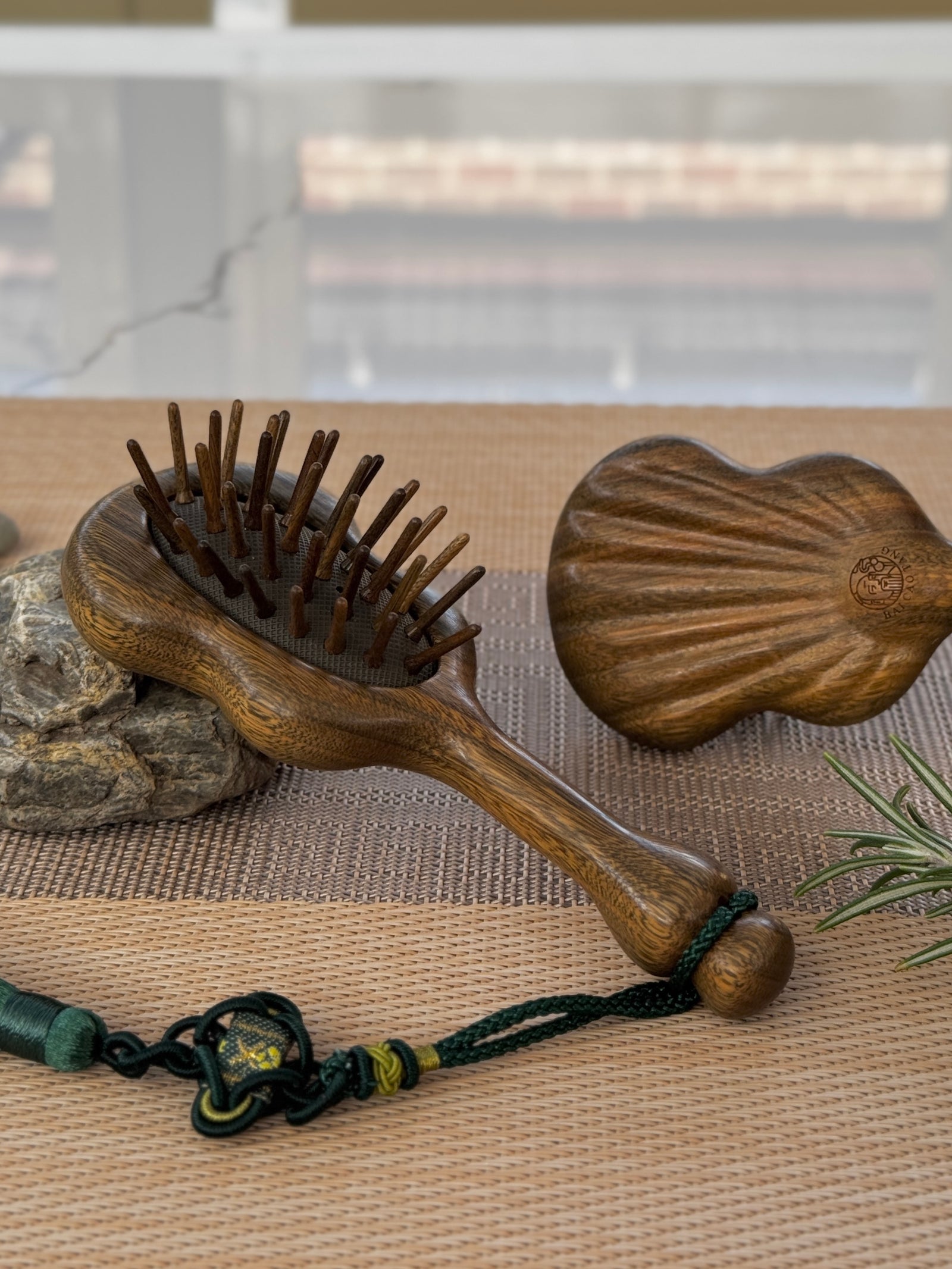
The Portable Sandalwood Cushion Scalp Brush pairs flexible pins with a spring-cushion base. Its compact body is carved from South American Green Sandalwood and hand-polished without lacquer or synthetic coating.
Use it after major knots are cleared and hair is no longer soaking wet. If used around light moisture, wipe the natural wood dry promptly and keep it away from standing water, direct heat and sun.
TURN DETANGLING INTO A GENTLER RITUAL

Real Bai Cao Tang product photographs. The outline, logo, proportions and natural wood grain have not been redrawn.
MELBOURNE CLINIC ROOTS
Everyday ritual, professional restraint
Bai Cao Tang Wellness grew alongside a Melbourne Traditional Chinese Medicine clinic. Traditional self-care gives slow combing a ritual context: deliberate movement, sensory attention and a transition from washing to rest. That context is not evidence that a comb treats hair loss, repairs fibres or changes a medical scalp condition.
The registered-practitioner perspective adds a practical guardrail: a home ritual should feel measured, be easy to stop and never replace appropriate assessment.
Frequently asked questions
Should I brush hair when it is soaking wet?
For wet detangling, the AAD recommends a wide-tooth comb rather than a brush. Thick or curly hair may be detangled with conditioner in the shower; straight hair can be allowed to dry a little first.
Why start at the ends?
Clearing the ends creates an exit route. You can then move slightly higher through an already organised section instead of collecting multiple tangles into one larger snag.
Does conditioner stop hair breakage?
Conditioner improves slip and manageability, and one tress study found that the tested conditioner reduced both types of breakage. That does not mean every formula will prevent breakage for every person.
Can a wooden cushion brush be used on damp hair?
It can be used around light moisture if wiped dry immediately. Do not soak natural Green Sandalwood or leave it in a humid shower area.
Can this routine repair split ends or treat hair loss?
No. Detangling technique changes grooming behaviour; it does not fuse damaged fibres or treat a medical cause of hair loss.
References
- American Academy of Dermatology. Tips for healthy hair. Updated 12 August 2024. Official guidance.
- Robbins C. Hair breakage during combing. II. Impact loading and hair breakage. J Cosmet Sci. 2006;57(3):245–257. PubMed.
- Robbins C, Kamath Y. Hair breakage during combing. III. The effects of bleaching and conditioning on short and long segment breakage by wet and dry combing of tresses. J Cosmet Sci. 2007;58(4):477–484. PubMed.
- Song S-H, Son SK. Hair Detangling Evaluation Method Using Section Detangling Rate. Cosmetics. 2025;12(2):82. DOI.
General information only. Laboratory tress findings do not predict an individual result and the cited studies did not test the Bai Cao Tang brush. Seek professional advice for sudden hair loss, persistent unexplained breakage, scalp pain, inflammation or broken skin.