“Four fingers below the knee” sounds simple. It can also place you on the wrong hollow, the hard edge of the shin or the wrong muscle.
A better guide begins with anatomy. The World Health Organization places Zusanli (ST36) 3 proportional B-cun below ST35, on the line toward ST41, over the tibialis anterior muscle. That gives you three practical checks before any pressure begins.
Tradition, anatomy and evidence are three different layers
ST36 belongs to the Stomach channel and has broad traditional functions. This is a Chinese medicine framework, not a modern anatomical diagnosis.
The surface location sits over tibialis anterior. Deeper neural anatomy matters to trained needling practice, not to home needling.
A small 2025 study did not find an advantage over sham pressure for the blood-flow and autonomic measures it tested.

Three landmarks that make ST36 easier to find

Begin with ST35
With the knee comfortably bent, find the depression beside the lower outer edge of the kneecap, lateral to the patellar ligament.
Trace the shin ridge
Identify the hard anterior border of the tibia. ST36 is not on that sharp edge; it sits just lateral to it, over muscle.
Confirm tibialis anterior
Keep the heel supported and gently lift the forefoot. The muscle should firm beneath your fingers.
A NOTE ABOUT “FOUR FINGERS”
B-cun is proportional body measurement, not a fixed centimetre value. Finger-width shortcuts vary between people. When the shortcut and the landmarks disagree, trust the landmarks—and ask a registered practitioner if you remain unsure.
A two-minute external-pressure method
This is a tactile self-care practice, not a treatment prescription. Support the foot, confirm that the skin and lower leg look and feel normal, and begin with a fingertip before introducing any tool.

For 30–60 seconds, hold steady or make very small circles. Release slowly, then compare the other side. One careful pass is more useful than repeated digging.
Why contact shape matters more than intensity
A narrow point can feel precise, but “more pointed” does not automatically mean “more effective”. For home use, control matters more than force.
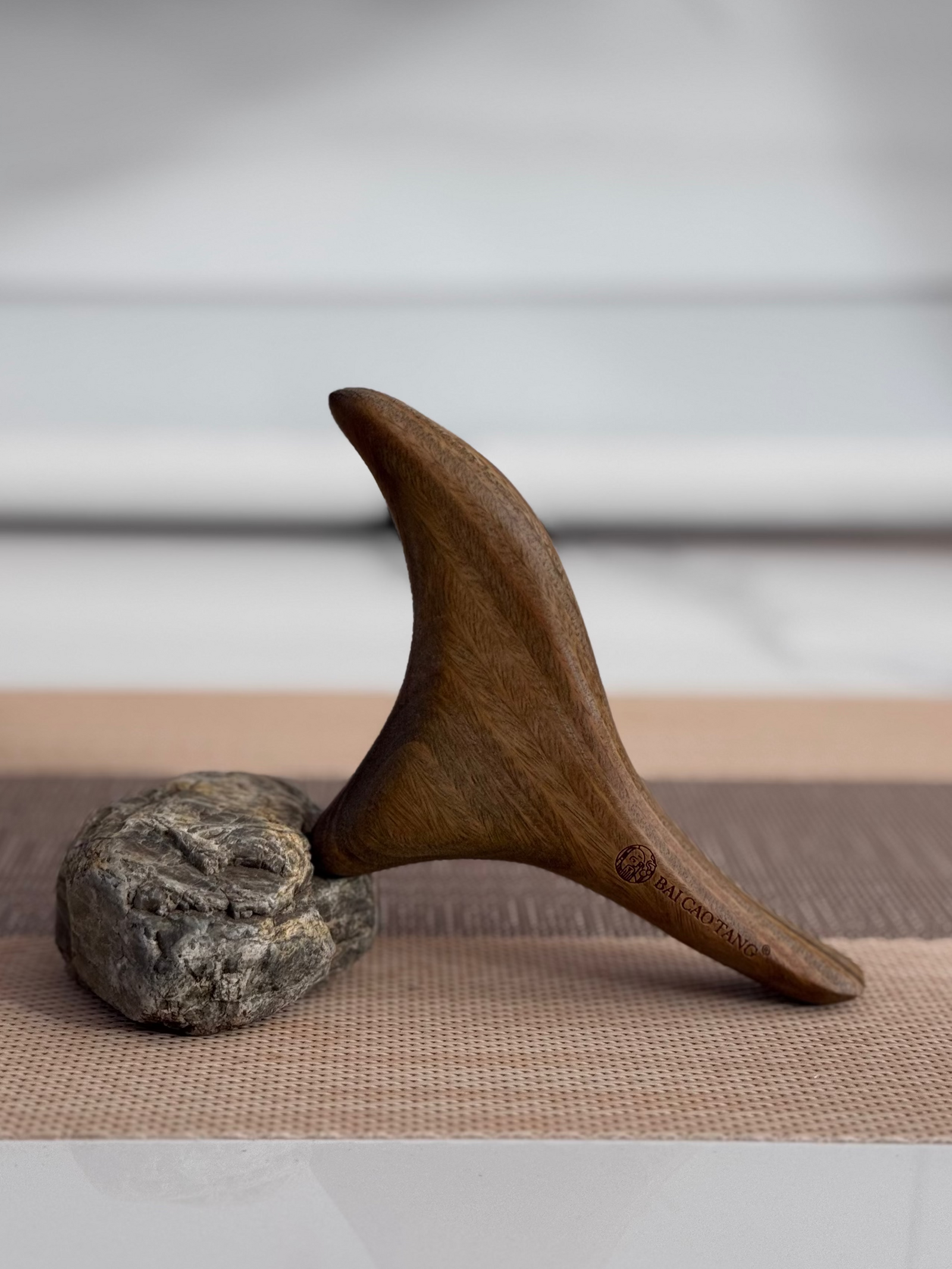
The Bai Cao Tang Tri-Point Acupressure Massager offers a rounded tip for measured point contact, a broad surface for the surrounding muscle and a focused end for experienced, carefully controlled use. For ST36, begin with the rounded tip.
The solid South American Green Sandalwood body provides a substantial hold. Its hand-polished surface is left without lacquer or synthetic coating, keeping the actual grain and wooden touch perceptible. These are observable material and design qualities—not evidence that the product produces a clinical outcome.

THREE CONTACT STYLES
Precision without chasing pressure
Start ST36 with the rounded tip. The solid unlacquered Green Sandalwood body gives the hand a stable hold, while the other surfaces remain available for broader muscle contact.
EXPLORE THE TRI-POINT TOOLMELBOURNE CLINIC ROOTS
Accuracy before intensity
Bai Cao Tang Wellness grew alongside a Melbourne Chinese medicine clinic. That background supports a simple content standard: identify the structure, explain the direction and keep safety boundaries visible.
In Australia, Chinese medicine practitioners must be registered with the Chinese Medicine Board of Australia. This regulated context does not turn a wooden tool into a medical device; it supports clearer education about where a home practice fits and when individual assessment matters.
When not to press the lower leg
Skip self-massage over broken or irritated skin, a recent injury, unexplained swelling, marked tenderness or reduced sensation. Healthdirect advises urgent assessment for a leg that becomes red, warm and swollen, and emergency help for accompanying chest pain or breathing difficulty.
Frequently asked questions
Is ST36 exactly four finger widths below the kneecap?
Not exactly. The WHO standard uses 3 proportional B-cun below ST35 and confirms the point over tibialis anterior. Finger-width shortcuts can only be approximate.
Should it hurt when I find the point?
No. Clear local contact is enough. Sharp, electrical, radiating or lingering pain is a reason to stop and reassess.
Can I use the pointed end?
Begin with the rounded end. A focused tip concentrates force into a smaller area and therefore requires more control, not more enthusiasm.
Does pressing ST36 improve circulation?
That cannot be promised. A small 2025 study found no advantage over sham pressure in the blood-flow and autonomic measures it tested.
Can this diagram be used for needling?
No. It is an external self-massage guide only. Needling requires appropriate professional training, registration and individual assessment.
References
- World Health Organization, Regional Office for the Western Pacific. WHO Standard Acupuncture Point Locations in the Western Pacific Region. 2008. Source.
- Lim S. WHO Standard Acupuncture Point Locations. Evidence-Based Complementary and Alternative Medicine. 2010;7(2):167–168. Source.
- Lee IS, et al. A deeper understanding of acupoints: Are superficial anatomical features sufficient? 2024. Source.
- Watanabe H, Hanaoka M, Sugi T, Masuda Y, Nagashima K. Single acupressure on ST36 does not modulate skin blood flow and sympathetic nerve activity during and after cold stimulation of the hand. J Physiol Sci. 2025;75:100011. DOI.
- Healthdirect Australia. Deep vein thrombosis. Reviewed 2025. Source.
- Australian Health Practitioner Regulation Agency. Regulating Australia’s Chinese medicine practitioners. Source.
Necessary limitation. Traditional point functions are presented as traditional theory. Anatomical proximity does not establish a therapeutic mechanism. The cited human study was small, tested a single short session and did not test a Bai Cao Tang product. This article provides general external self-massage education and does not replace individual medical care.