A tense day rarely announces itself all at once. It can show up as a clenched jaw, tired eyes, restless hands or the feeling that your attention never quite leaves the screen. A short pause will not remove the cause, but it can give the body a clear transition between one part of the day and the next.
In Chinese medicine, point-based self-massage is one way of creating that pause. This guide explores three commonly recognised locations—LI4 Hegu, PC6 Neiguan and EX-HN3 Yintang—and turns them into a simple three-minute ritual you can use at your desk or at the end of the day.
The aim is not to chase an intense sensation. It is to locate each area carefully, settle into controlled pressure, breathe slowly and notice how the ritual feels.
BEFORE YOU BEGIN
Good pressure begins
with a clear landmark.
Acupoints are described by anatomical landmarks rather than by a vague tender spot. Use the diagrams below to orient yourself, then keep the contact steady and comfortable. A strong sensation is not a sign that the technique is better.
Three rules for self-massage
- Locate first: find the landmark before adding pressure.
- Build gradually: start lightly, then settle into a clear but comfortable sensation.
- Release slowly: lift away rather than abruptly breaking contact.

POINT 01 · LI4 HEGU 合谷
Begin with the hand.
Where it is: LI4 is located on the back of the hand, on the thumb side of the midpoint of the second metacarpal bone. Using the bone as your reference is more precise than choosing the centre of the web between the thumb and index finger.
Traditional context: Hegu is a frequently used point in Chinese medicine and is traditionally associated with the face and head. In a personal wellbeing routine, it also offers a practical reason to stop gripping the mouse or phone and give the hand a moment of attention.
Try this: support the hand so the fingers can soften. Place one rounded front head of the massage comb beside the midpoint of the second metacarpal, build to comfortable pressure and stay for about 30–60 seconds while breathing normally.

POINT 02 · PC6 NEIGUAN 内关
Move to the inner wrist.
Where it is: PC6 sits on the palm-side forearm, two proportional body inches above the wrist crease, between the palmaris longus and flexor carpi radialis tendons.
What research has explored: PC6 is among the most studied acupoints. A Cochrane review examined PC6 stimulation for postoperative nausea and vomiting and found benefits over sham in that specific clinical setting, while also noting limits in the evidence. It is a useful example of why careful point location and clearly defined technique matter.
Try this: rest the forearm palm-up. Find the two tendon lines, settle one rounded front head of the comb onto the space between them and maintain comfortable, stationary contact for 30–60 seconds. Keep the wrist relaxed rather than bending it towards the pressure.

POINT 03 · EX-HN3 YINTANG 印堂
Finish between the brows.
Where it is: Yintang lies at the glabella, midway between the inner ends of the eyebrows. Stay on the bony central area and remain completely clear of the eyelids and eye sockets.
Traditional and research context: Yintang is traditionally associated with calming the Shen. Small clinical studies have explored Yintang stimulation in anxiety-related settings, including pre-procedure and preoperative anxiety. Together, the traditional use and emerging research help explain why this point often appears in rituals centred on stillness and transition.
Try this: use the lightest pressure of the three locations. Rest one rounded front head of the comb on the midpoint for 30–60 seconds, keep the forehead soft and let the exhale lengthen naturally. Stop immediately if the contact feels sharp or approaches the eye area.
PUT THE THREE TOGETHER
Hand. Wrist. Brow.
A reset that fits between tasks.
You do not need to turn the sequence into a long routine. Use it after closing the laptop, before beginning an evening ritual or whenever you want a clear transition.
Hegu
Support the hand and settle beside the second metacarpal for up to 60 seconds.
Neiguan
Rest the forearm palm-up and use steady contact between the wrist tendons.
Yintang
Finish with feather-light contact on the bony midpoint between the brows.

WHEN A TOOL MAKES THE RITUAL EASIER
A small point of contact,
then a wider flow.
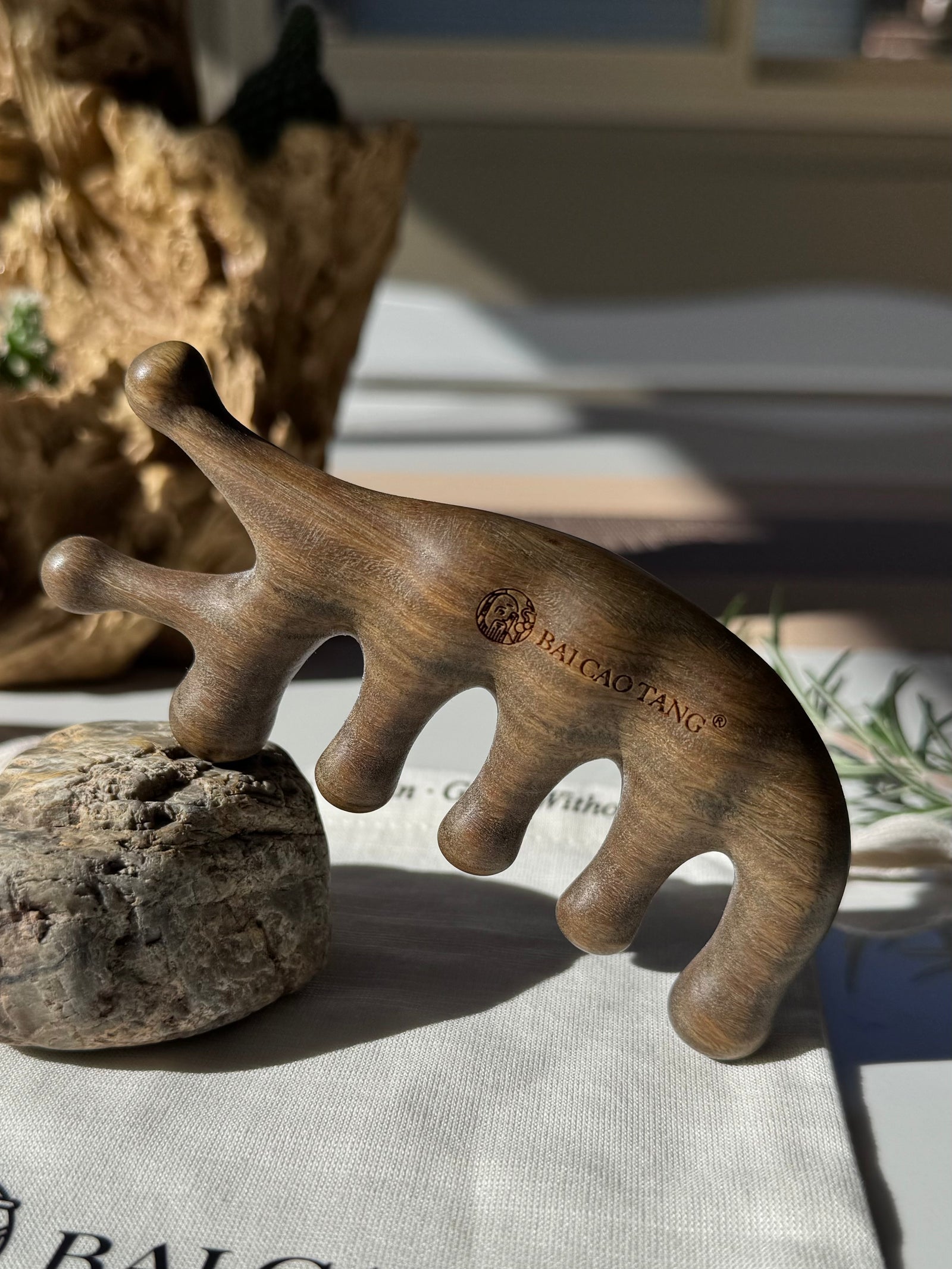
You can practise point-based self-massage in different ways. If you prefer using a dedicated object, the Bai Cao Tang Seven-Tooth Green Sandalwood Massage Comb brings two movements into one form.
How the shape fits this sequence
- Two rounded front heads provide a small contact area for the three locations described above.
- Seven broad polished teeth let you continue from a stationary hold into slower massage across the palm, forearm, scalp or temples.
- A sculpted solid-wood body gives the hand a stable grip while the natural grain makes every piece visually individual.

ROOTED
MELBOURNE CLINICAL ROOTS
Technique first. Product second.
Bai Cao Tang Wellness grew from a Melbourne Chinese medicine clinic. That background shapes the way we talk about self-massage: locate carefully, use controlled contact and understand the difference between a personal wellbeing ritual and clinical care.
Our Seven-Tooth Comb is carved from solid South American Green Sandalwood. Its two rounded front heads and seven broad teeth were chosen to support different kinds of external massage within one tactile object.
COMMON QUESTIONS
How often can I use this three-point sequence?
It can sit within a short daily wellbeing routine if the skin remains comfortable. Start with one round and notice how you respond before repeating it.
Do I need to press hard?
No. Accurate placement and controlled contact matter more than force. Reduce pressure or stop if you experience sharp pain, numbness or lingering irritation.
Can I continue into a broader massage?
Yes. After releasing a point, the seven broad teeth can be used slowly across suitable external areas such as the palm, forearm, scalp or temples. Keep away from the eyes and do not use over broken, inflamed, infected, bruised, recently operated-on or numb skin.
Why does each Green Sandalwood comb look slightly different?
Natural variations in colour, grain and resin-like patterning are characteristics of solid South American Green Sandalwood rather than printing or artificial surface effects.
A MORE CONSIDERED DAILY PAUSE
Three points to remember.
One object designed to stay in your ritual.
If you enjoy the sequence and want a dedicated tool for both focused contact and broader massage, explore the Seven-Tooth Green Sandalwood Body & Face Massage Gua Sha Comb.