Temple massage should begin with location—not force.
A long afternoon often sends two fingers toward the side of the face. Taiyang (EX-HN5) turns that automatic gesture into a more precise one: use the eyebrow tail, outer eye corner and soft temporal depression to place light pressure away from the eye socket.
Start with three landmarks, not a guess
First, identify the lateral end of the eyebrow. Then find the outer corner of the eye. Imagine a short line joining those two points and locate its midpoint. From that midpoint, move approximately one finger-width backward—away from the eye—until you feel the shallow, softer depression at the temple.
That depression is the usual surface location described for Taiyang, also written as Tàiyáng, 太阳 or EX-HN5. Peer-reviewed facial anatomy work places it in the temporal region and discusses its relationship to sensory branches of the trigeminal nerve. A 2023 clinical study used the same landmark description when locating Taiyang for acupuncture.
ACCURACY CHECK
The point should not sit on the eyelid, at the outer eye corner or on the hard orbital rim. If your finger is pressing inward toward the eye, return to the landmarks and move posteriorly.

Why the anatomy calls for a lighter hand
The temple is not an empty flat surface. The temporalis muscle occupies the temporal fossa, while fascia and variable superficial vessels cross the region. The superficial temporal artery travels upward in front of the ear and divides into branches whose pattern varies between people.
This is why the best pressure cue is simple: contact the skin, settle into the soft depression and keep the movement small. You do not need deep inward force, aggressive scraping or visible skin dragging to make the ritual feel deliberate.
The Victorian Department of Health notes that headaches have many possible contributors, including muscle tension, stress, jaw or eye problems and underlying health conditions. A temple ritual is best framed as a brief self-care pause—not a way to diagnose recurring head pain.

Traditional context and current evidence are different layers
In traditional Chinese medicine, Taiyang is an extra point commonly associated with the temporal and eye region. That traditional use explains why the point appears in facial and head-care teaching.
Modern research asks different questions. The 2020 facial anatomy paper examined how recognised facial acupoints relate to trigeminal nerve anatomy. A small 2023 study involved 18 young adults with myopia and tested 20 minutes of acupuncture at right Taiyang alongside visual and EEG measurements. It was a needling study—not a trial of self-pressure, a wooden tool or a Bai Cao Tang product.
The useful conclusion is appropriately narrow: Taiyang has a reproducible anatomical location, while claims about treating headache, improving eyesight or relieving eye strain should not be transferred to a home massage ritual.
A measured 90-second temple sequence
1 · Locate — 20 seconds
Use the eyebrow tail and outer eye corner to find the midpoint, then move one finger-width backward into the soft depression. Check both sides separately.
2 · Settle — 20 seconds per side
Rest the middle-finger pad on the point. Add only enough pressure for comfortable tissue contact. Keep the direction perpendicular to the skin, not inward toward the orbit.
3 · Circle — 15 seconds per side
Make three circles smaller than a five-cent coin. Let the skin move minimally, breathe out slowly and relax the jaw.
4 · Release — 10 seconds
Reduce pressure before lifting away. Blink naturally and stop if the area feels more uncomfortable.
Once a day is sufficient for a short general-wellness ritual. There is no advantage in chasing tenderness or repeating until the skin is sore.
What to look for in a temple tool
If fingertips already give you good control, they are the correct place to begin. A tool becomes useful when its structure makes the same light, repeatable contact easier—not when it encourages more force.
- A rounded contact end rather than a sharp corner.
- A stable handle that does not require wrist tension.
- A smooth, intact surface that does not catch skin.
- A contact size that stays outside the orbital rim.
- Clear cleaning and storage instructions.
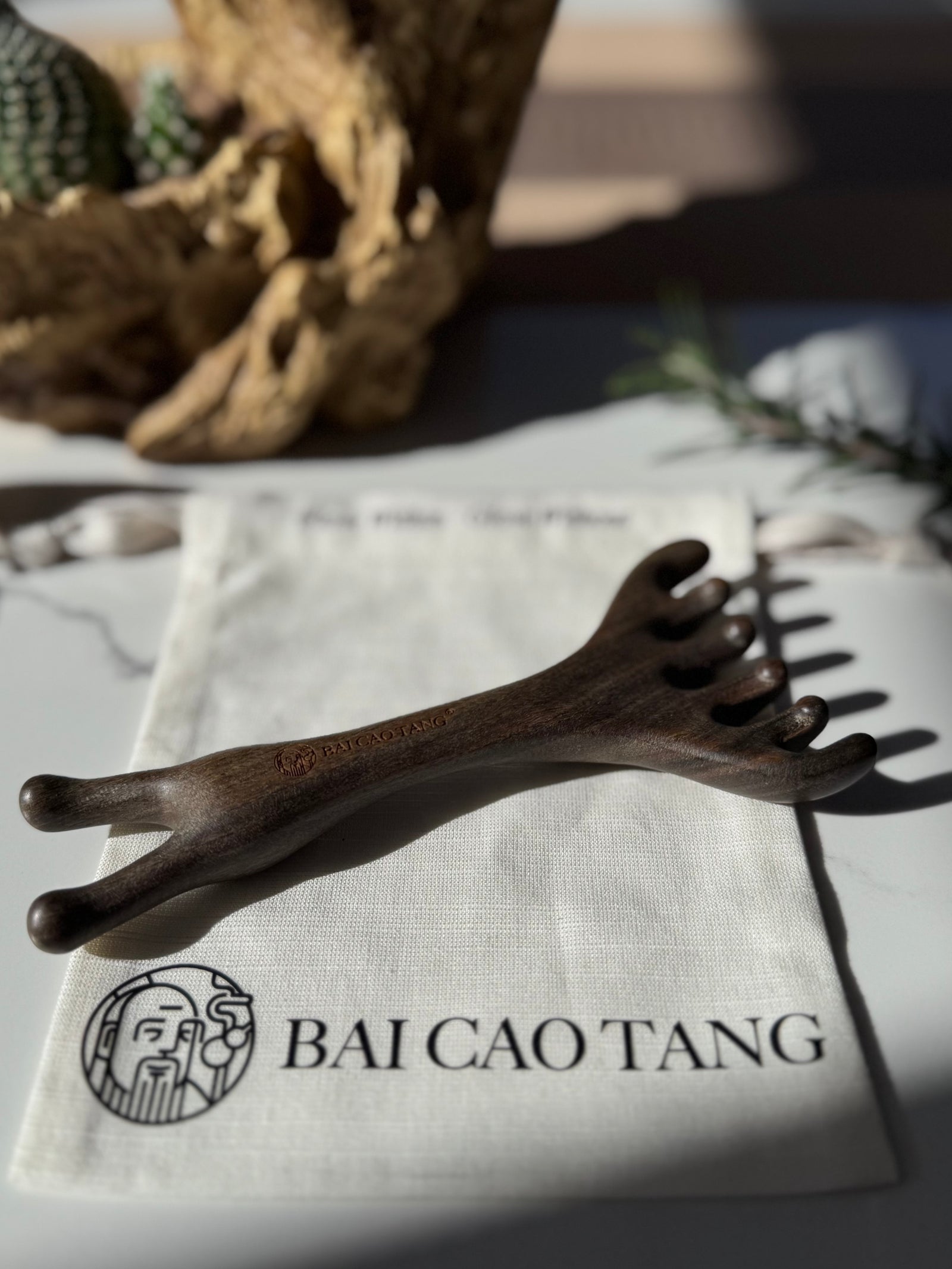
The Bai Cao Tang Sandalwood Antler Dual-End Face & Scalp Massager Tool uses finger-like rounded tips for small facial contact areas and a thickened handle for control. Its opposite comb end has six curved, rounded teeth for broader scalp passes. Those two ends serve different jobs; the antler end—not the comb teeth—is the relevant end for a light temple hold.
The tool is carved from solid South American Green Sandalwood identified by Bai Cao Tang as Bulnesia arborea and hand-polished without lacquer or synthetic surface coating. The direct wood surface feels naturally warm in the hand, while visible grain and tone make each piece individual. Wipe it after use, keep it dry and avoid soaking or prolonged heat.
MELBOURNE CLINIC ROOTS
Guidance should make the method clearer
Bai Cao Tang Wellness is shaped by the practical background of a Melbourne Chinese medicine clinic and registered Chinese medicine practitioners. That is expressed through the details: landmarks before pressure, one working end selected for the task, a light external direction and a clear point at which self-care stops.
Know when not to massage
Do not massage over broken, inflamed, infected or recently treated skin. Avoid the area after facial procedures unless the treating practitioner has cleared it. Stop with sharp pain, pulsing discomfort, dizziness or visual symptoms.
Seek prompt medical advice for a new or severe headache, persistent or changing symptoms, headache after injury, jaw pain with temple tenderness, or blurred/double vision. Healthdirect advises urgent assessment when severe headache, temple tenderness and visual symptoms suggest giant cell arteritis, particularly in adults over 50.
Frequently asked questions
Is Taiyang on the outer corner of the eye?
No. Take the midpoint between the eyebrow tail and outer eye corner, then move about one finger-width backward into the soft temple depression. Keep all pressure outside the bony eye socket.
How hard should I press?
Begin with feather-light contact and add only enough pressure for comfortable tissue contact. Sharpness, throbbing, eye discomfort or lingering tenderness means the pressure is too much or the location should be rechecked.
Should I use fingers or a tool?
Start with a fingertip for immediate feedback. A smooth rounded tool can then reproduce the same light external direction with a stable grip. It is for control and consistency, not greater force.
Which end of the dual-end tool belongs at the temple?
Use one smooth rounded tip on the antler end for a small, controlled hold. Keep the six-tooth comb end for broader scalp passes. One working end for one task makes pressure easier to place and repeat.

CONTROLLED TEMPLE CONTACT
A rounded end for a more precise hold.
Finger-like tips, a stable thickened handle and an unlacquered South American Green Sandalwood surface support light, repeatable external contact.
EXPLORE THE DUAL-END MASSAGERReferences
- Meltz L, Ortiz D, Chiang P. The Anatomical Relationship Between Acupoints of the Face and the Trigeminal Nerve. Medical Acupuncture. 2020;32(4):181–193.
- Su K, Wang L, Wang Z, et al. The effect of acupuncture at the Taiyang acupoint on visual function and EEG microstates in myopia. Frontiers in Integrative Neuroscience. 2023;17:1234471.
- Daskalopoulou D, et al. The Superficial Temporal Artery: Anatomy and Clinical Considerations.
- Better Health Channel, Victorian Department of Health. Headache. Accessed 5 August 2026.
- Healthdirect Australia. Polymyalgia rheumatica — giant cell arteritis warning signs. Accessed 5 August 2026.
- Bai Cao Tang Wellness. Sandalwood Antler Dual-End Face & Scalp Massager Tool. Accessed 5 August 2026.
Evidence boundary: anatomical sources support point location and regional structures. The 2023 study tested acupuncture in 18 participants and does not validate acupressure, massage tools or Bai Cao Tang products. Product statements are limited to observable structure, stated material/finish, handling and general external self-massage.