You find two wooden massage tools online. Both are called “sandalwood”. One page names the species, finish, dimensions and care. The other offers only a colour and a poetic promise.
They may not be the same material at all.
Common names travel easily between markets; botanical identity does not. If you are buying a tool intended to spend years in your hand, “natural wood” is not enough information. The most useful questions are simple: Which species? What finish? What structure? What care does it need?
The word “sandalwood” is not a botanical identity
Royal Botanic Gardens, Kew places three woods commonly encountered under sandalwood-style names in three different plant families. Bai Cao Tang’s material is identified as Bulnesia arborea, which Kew treats as a synonym of the currently accepted Plectrocarpa arborea, in the Zygophyllaceae family. Its native range is Colombia to Venezuela.
Indian sandalwood, Santalum album, belongs to Santalaceae and is native from Java to northern Australia. Red sanders, Pterocarpus santalinus, belongs to Fabaceae and is native to southern India.
That does not make one automatically “better” than another. It means the shared word sandalwood cannot tell you what the object is made from.

Why Bai Cao Tang uses both names
Bai Cao Tang identifies its wooden tools as South American Green Sandalwood, Bulnesia arborea. This is an established botanical synonym still widely used in timber and trade references. Current Kew taxonomy accepts the name Plectrocarpa arborea.
Showing both is not a contradiction. It is a clearer chain of identity: the familiar scientific name used in the product market, connected to the current accepted botanical name.
What the timber reference actually tells us
The US Forest Products Laboratory describes Bulnesia arborea wood as fine-textured and cross-grained, with an oily appearance and feel. Its heartwood may range from light olive green to chocolate brown, and freshly exposed wood can darken toward green. The reference also records a mild scent when warmed.
The density figure is a species-level timber reference—not a laboratory test of a Bai Cao Tang product—but it helps explain why a small solid-wood tool can feel unexpectedly substantial.
The same source notes that the timber’s high density and resinous nature make it slow to dry and demanding to work. For a finished wellness tool, those facts translate into a dense hand-feel and a need for careful, dry storage rather than casual soaking.
Unlacquered is a sensory choice—and a care responsibility
A coating is not inherently bad, and an unlacquered tool is not automatically superior in every situation. The difference is what sits between your hand and the wood.
Bai Cao Tang tools are hand-polished without lacquer or synthetic surface coating. You can feel the actual grain and natural surface character rather than a sealed film. Variations in tone, striping and wood pattern remain visible instead of being made factory-identical.
That direct material experience is part of the appeal. It also asks for more mindful care. The US Forest Products Laboratory’s Wood Handbook explains that wood exchanges moisture with its environment and that coatings can slow, but not completely prevent, moisture change.
THE PRACTICAL RULE
Wipe promptly, keep dry and ventilated, and protect natural wood from prolonged water, direct heat and strong sun.
A five-point check before you buy

Look for the scientific name
“Premium sandalwood” is a marketing description. A scientific name is a checkable identity. If the seller cannot provide one, you cannot reliably compare the material.
Ask what is on the surface
Look for a clear statement such as lacquered, oil-finished, waxed, coated or hand-polished without a synthetic coating. Each creates different touch and care expectations.
Inspect real photographs
Real product images should show grain, tooth profile, edges, engraving, proportions and finish. Perfectly identical colour across every piece can be a reason to ask more questions—not proof of quality.
Match the design to the intended use
Material alone does not make an effective self-massage tool. Contact area, tooth shape, curve and grip determine how controllable it feels.
Read the care and packaging details
Bai Cao Tang shipped orders include a wooden gift box and natural linen drawstring pouch. Melbourne pickup orders include the linen pouch only; sets do not support pickup. Precise details help buyers know exactly what they will receive.
Why this level of detail matters
Trust does not come from calling a material “rare”, “sacred” or “luxury” often enough. It comes from giving the buyer information that can be checked.
THE BAI CAO TANG MATERIAL STANDARD
- South American Green Sandalwood identified as Bulnesia arborea.
- Solid wood rather than imitation wood print.
- Hand-polished without lacquer or synthetic coating.
- Real product photography showing actual grain and structure.
- Tool geometry designed around a stated massage purpose.
- Practical care instructions and transparent packaging differences.
This does not mean every piece will have the same shade or grain. It means the reason for choosing it is visible: named material, direct touch, deliberate structure and clear care.

MATERIAL MEETS GEOMETRY
28 contact points. One controlled hold.
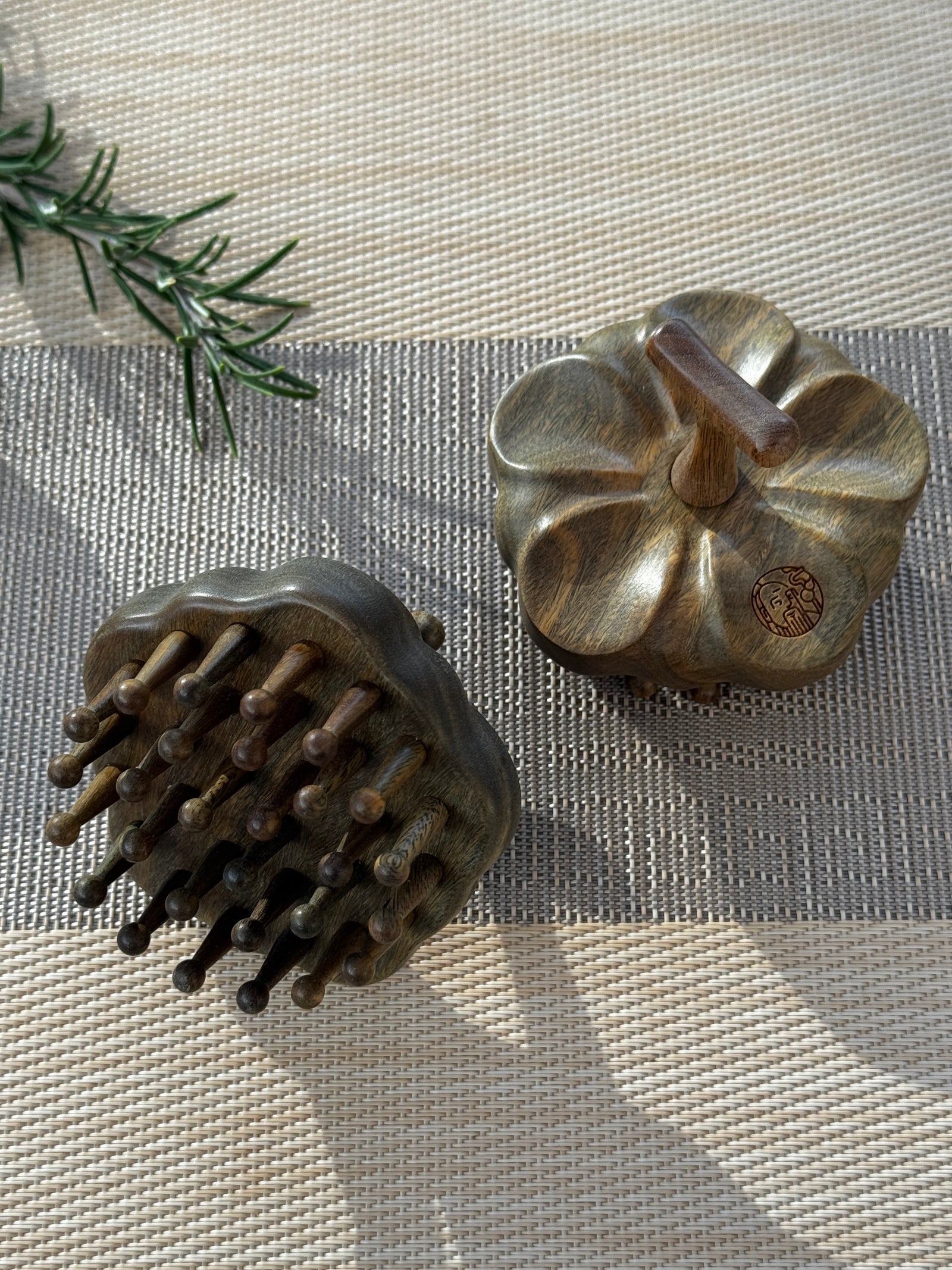
The 28-Tooth Petal Scalp Massage Comb uses longer outer teeth and shorter inner teeth in a concave arrangement intended to follow the curve of the head. Rounded tips distribute contact, while the petal grip helps the hand control slow passes without holding a narrow handle.
Its solid South American Green Sandalwood body is hand-polished without lacquer or synthetic coating, leaving the actual grain and warm wooden touch visible.
EXPLORE THE 28-TOOTH GREEN SANDALWOOD RITUALReal Bai Cao Tang product photograph. The logo, 28-tooth structure, outline and natural wood grain have not been redrawn.
MELBOURNE CLINIC ROOTS
Specificity before spectacle
Bai Cao Tang Wellness grew alongside a Melbourne Chinese medicine clinic. That background shapes a simple standard: technique should be understandable, pressure should remain proportionate, and product claims should stay within what the material and design can honestly support.
Registered Chinese medicine experience is not used to turn a wooden object into a medical promise. It is used to explain where a tool fits, how to handle it and when a home ritual should give way to individual professional advice.
Frequently asked questions
Is Green Sandalwood the same as Indian sandalwood?
No. Bai Cao Tang’s Green Sandalwood is identified as Bulnesia arborea (currently accepted by Kew as Plectrocarpa arborea) in Zygophyllaceae. Indian sandalwood is Santalum album in Santalaceae.
Is Green Sandalwood the same as red sandalwood?
No. Red sanders is Pterocarpus santalinus, a separate species in the Fabaceae family.
Does a darker green colour prove authenticity?
Colour alone cannot prove species. Bulnesia arborea timber can vary from olive green to brown and may darken with exposure, but reliable identification should not depend on a photo or colour claim alone.
Is an unlacquered tool better?
It offers a more direct wood touch and leaves natural grain visible. It also requires dry, considerate care. “Better” depends on whether you value that tactile experience and are comfortable maintaining natural wood.
Does high density make massage more effective?
No clinical conclusion follows from timber density alone. Density can influence weight and hand-feel; control, comfort, contact shape and technique still matter.
How should I clean it?
Wipe it with a soft dry cloth after use and keep it dry and ventilated. Avoid soaking, prolonged moisture, direct heat and strong sun.
References
- Royal Botanic Gardens, Kew. Plectrocarpa arborea (Jacq.) Christenh. & Byng. Plants of the World Online. Accessed 27 July 2026. Source.
- Royal Botanic Gardens, Kew. Bulnesia arborea (Jacq.) Engl.—synonym record. Accessed 27 July 2026. Source.
- Royal Botanic Gardens, Kew. Santalum album L. Accessed 27 July 2026. Source.
- Royal Botanic Gardens, Kew. Pterocarpus santalinus L.f. Accessed 27 July 2026. Source.
- US Forest Products Laboratory. Bulnesia arborea: Verawood, Maracaibo Lignum-Vitae. Technical sheet.
- Glass SV, Zelinka SL. Moisture Relations and Physical Properties of Wood. In: Wood Handbook—Wood as an Engineering Material. US Forest Products Laboratory. Chapter PDF.
Necessary limitation. Botanical databases and trade terminology can change, and wood species cannot be authenticated from colour, scent or photography alone. USDA timber figures describe reference material for the species; they are not measurements of an individual Bai Cao Tang tool. This article provides buyer education, not medical or forensic identification advice.