You bought a beautiful gua sha board, applied your serum—and then paused. How hard should you actually press?
On social media, dramatic redness can look like proof that a ritual is “working.” For a gentle facial routine, it is a poor target. More force can mean more friction, less control and an experience you are less likely to repeat. A better ritual feels smooth, deliberate and comfortable enough to become part of your week.
At Bai Cao Tang Wellness, our clinic-informed approach begins with a simple principle: let technique lead and pressure follow.
READING THE EVIDENCE
The pressure myth:
intensity is not the goal.
Traditional body gua sha and modern facial gua sha are not interchangeable. In traditional East Asian clinical practice, press-stroking on the body may intentionally produce temporary red or purple marks known as sha. A home facial ritual is gentler, uses a smoother glide and should not chase bruising.
For the face, think contact rather than force.
- Use enough skincare slip for an easy glide.
- Keep the broad edge low and supported.
- Reduce pressure if the skin bunches or drags.
- Stop if the movement hurts or causes marked irritation.
WHAT THE STUDY OBSERVED
A short-term local
microcirculation signal.
A small 2007 pilot study used laser Doppler imaging after one gua sha treatment on the back. Researchers observed an approximately fourfold rise in local surface microcirculation during the first 7.5 minutes, with values remaining significantly above baseline across the 25-minute follow-up.
What that does—and does not—mean
- The study measured a short-term response on the back.
- It did not test permanent facial lifting or reshaping.
- It was not a trial of any Bai Cao Tang product.
- Lasting cosmetic change has not been established.
REPORTED DATA
≈4×Local surface microcirculation during the first 7.5 minutes
N=11 healthy adults · one treatment on the back · laser Doppler imaging
A FOUR-MINUTE FACIAL RITUAL
Glide gently.
Let comfort set the pressure.
Use slow, single-direction passes and the lightest contact that maintains an easy glide.
Prepare
Clean the board and your hands. Apply a facial oil, serum or moisturiser that your skin already tolerates, using enough to avoid dry dragging.
Cheeks
Place the broad edge beside the nose and glide outward toward the ear. Repeat a few unhurried passes on each side without sawing back and forth.
Jawline
Begin near the centre of the chin and glide toward the ear with comfortable contact. Do not press directly into a painful area.
Forehead & finish
Glide from the centre of the forehead outward. Clean the board according to its care instructions and allow it to dry fully before storage.
WHY THE TOOL’S SHAPE MATTERS
A broader edge for a
slower, steadier glide.
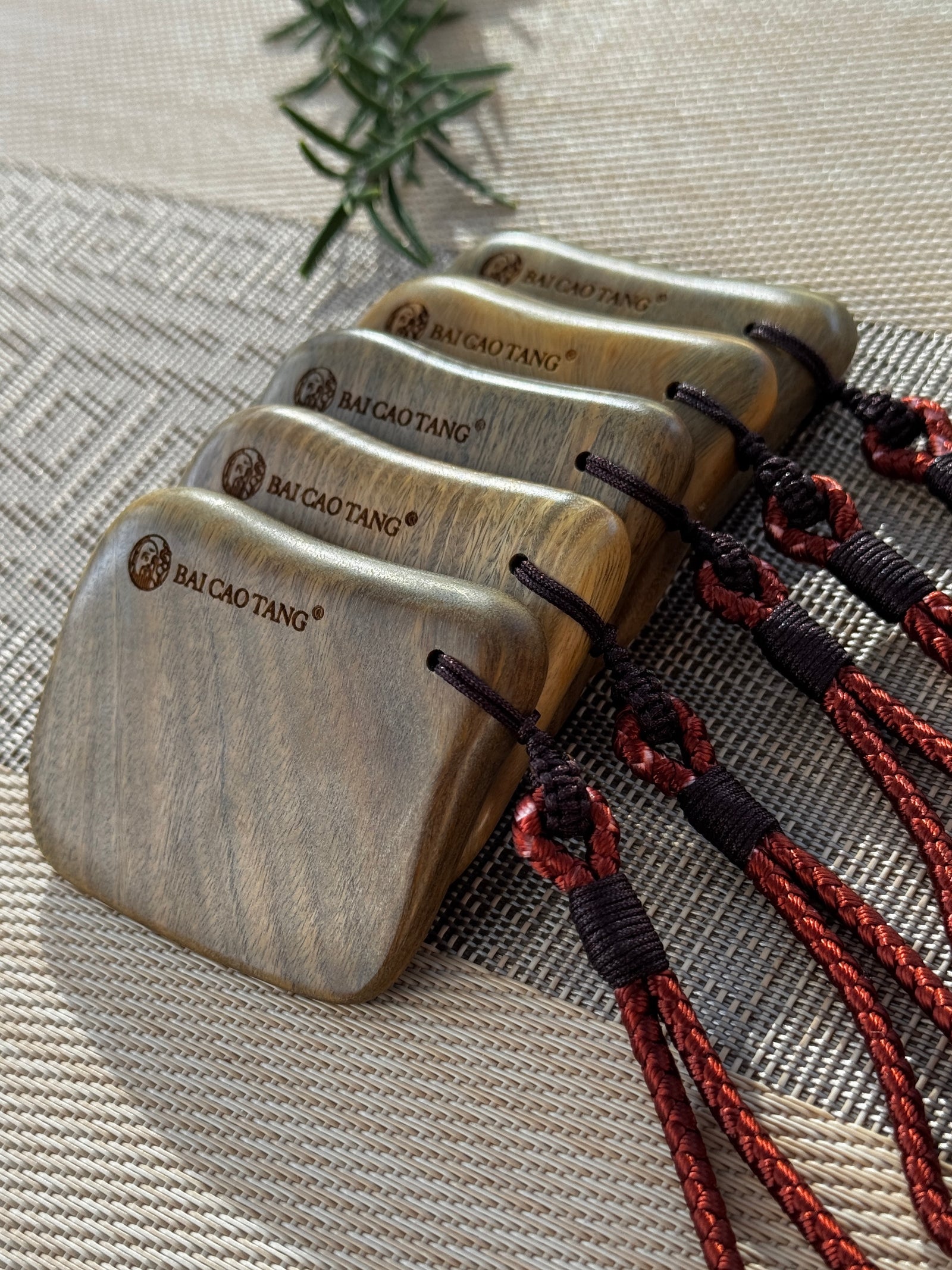
A ritual becomes easier to repeat when the tool feels controlled in the hand. The Bai Cao Tang Square Sandalwood Gua Sha Tool is approximately 70 × 55 mm, with a compact square form and broad, hand-polished edges designed for smooth facial gliding.
Each board is carved from solid South American Green Sandalwood (Bulnesia arborea) and finished without lacquer or chemical coating. Natural grain and tone vary from piece to piece—part of the quiet character of real wood, not a printed imitation.
The board’s value is not that it “works harder” for you. Its warm tactile feel, stable grip and broad contact edge make a slower, more intentional technique feel natural.
ROOTED
MELBOURNE CLINICAL ROOTS
Traditional perspective.
Measured modern language.
Bai Cao Tang Wellness was founded by practising clinicians in Melbourne. Dr Kevin Chen is registered with the Australian Health Practitioner Regulation Agency as a Chinese Medicine Practitioner, Acupuncturist and Chinese Herbal Medicine Dispenser. That background shapes our preference for clear technique, mindful external self-massage and tools made for everyday ritual—not exaggerated promises.
FREQUENTLY ASKED QUESTIONS
A gentler standard,
clearly explained.
Should facial gua sha leave red marks?
You do not need to pursue redness or bruising in a gentle facial routine. A little temporary warmth or colour may occur, but pain, marked irritation or bruising means the pressure or friction was too much for you.
Can facial gua sha permanently lift or reshape my face?
Current evidence does not establish permanent facial lifting or anatomical reshaping. Approach it as a gentle self-massage and skincare ritual rather than a structural treatment.
How often can I practise?
Consistency matters more than intensity. Start with short, gentle sessions and adjust to your skin’s response. Stop if irritation develops. For a research-backed ten-minute schedule, see How Often Should You Use Facial Gua Sha?
Can I use it on dry skin?
For facial use, apply a compatible oil, serum or moisturiser to reduce drag. Choose products appropriate for your own skin.
When should I avoid gua sha?
Do not use it over sunburn, broken skin, active rash, infection or recently treated skin. Seek personalised advice before use if you bruise easily, take anticoagulant medication, have a bleeding or circulation condition, or are unsure whether it is suitable for you.
Softer pressure. Better control. A ritual worth repeating.