The first question is often, “How hard should I press?” A better question is, “What rhythm can my skin comfortably repeat?”
Facial gua sha is frequently shown as a race toward a sharper contour or deeper redness. Yet the most useful recent study did not build its protocol around dramatic pressure. It built it around time and consistency: ten minutes, five times per week, for eight weeks.
That does not turn one research schedule into a rule for every face. It does give us something more useful than hype—a measured starting point.
What the newest facial gua sha trial actually tested
In 2025, researchers randomly assigned 34 women aged 20 to 50 to either a facial gua sha group or a facial roller group. Both groups followed a standardised ten-minute routine, five times per week, for eight weeks.
The researchers measured facial surface distances, muscle oscillation frequency, dynamic muscle stiffness and skin elasticity. In the gua sha group, measured facial surface distances decreased by 2.23 to 2.40 mm. Muscle oscillation frequency decreased by 2.02 Hz, while dynamic stiffness decreased by 56.46 N/m. The roller group showed larger changes in the skin-elasticity indices measured by the study.
These outcomes suggest that two tools may create different mechanical experiences: gua sha was more strongly associated with changes in the study’s muscle-property measurements, while the roller showed stronger elasticity signals. The study was small and compared two active routines rather than including a no-massage control, so the findings are encouraging rather than final.

The practical lesson is consistency, not intensity
The trial’s most consumer-friendly result is not a millimetre or a laboratory unit. It is the structure.
Ten minutes is long enough to slow down and divide the face into zones. Five sessions per week leave room for rest days. Eight weeks shifts attention away from chasing an instant transformation and toward noticing how the ritual fits into ordinary life.
The American Academy of Dermatology advises against scrubbing the face and recommends being gentle around the eyes so delicate skin is not pulled. That principle transfers neatly to facial massage: the tool should travel because the surface has enough slip, not because the hand is forcing it forward.
THE RITUAL TEST
If the tool stalls, the answer is usually more glide, a flatter angle or less pressure—not a stronger pull. For a closer look at why pressure is the wrong measure of a good ritual, see Softer Pressure, Better Ritual.
A ten-minute facial gua sha rhythm
Use the sequence as a calm framework rather than a medical protocol. Begin with clean, intact skin and a clean tool. Choose a simple facial oil, balm or serum that suits your skin and provides enough slip for the board to move without dragging.

Prepare the glide
Press your chosen product into the face and neck with clean hands. Test one short stroke near the jaw. If the skin bunches in front of the tool, add more slip or reduce pressure.
Neck and jaw
Use the broad edge and keep most of the board close to the skin rather than standing it upright. Support the skin with the free hand. Travel in short, unhurried passes along the side of the neck and from the centre of the chin toward the ear.
Cheeks and temples
Begin beside the nose or mouth and glide outward across the cheek. Let the board follow the face rather than trying to reshape it. At the temple, pause with still, light contact instead of repeatedly rubbing the same point.
Forehead and brow
Use slow outward strokes from the centre of the forehead. Around the brow, keep pressure lighter and stay on the bone rather than the eyelid. Fresh redness, discomfort or a hot, scratchy feeling is a reason to stop.
Finish and observe
Put the tool down. Notice whether the skin feels comfortable and calm. Wipe the wooden board promptly with a soft cloth so skincare residue does not remain on the surface.
How often is “often enough”?
The research protocol used five sessions per week, but your starting frequency can be lower. Two or three short sessions allow you to assess the skincare product, the pressure and how your skin responds.
Frequency should decrease—not pressure increase—if your skin is dry, sensitised, recently exfoliated or adjusting to strong active skincare. Do not use the tool over broken, inflamed, sunburned or actively irritated skin. Avoid facial gua sha immediately after procedures unless your treating clinician has cleared it.
A comfortable ritual is repeatable. A ritual that leaves the skin sore is giving you useful feedback.
Where tradition and current evidence meet
Traditional Chinese gua sha uses deliberate surface strokes within a broader meridian and circulation framework. Facial beauty routines are a gentler modern adaptation; they are not the same as therapeutic body gua sha that intentionally creates petechiae.
The modern trial contributes preliminary evidence that a standardised facial routine can produce measurable group-level changes over eight weeks. Traditional practice contributes the rhythm: prepare, glide, pause and observe. Neither requires the face to be aggressively scraped.
Why the shape and material change the experience
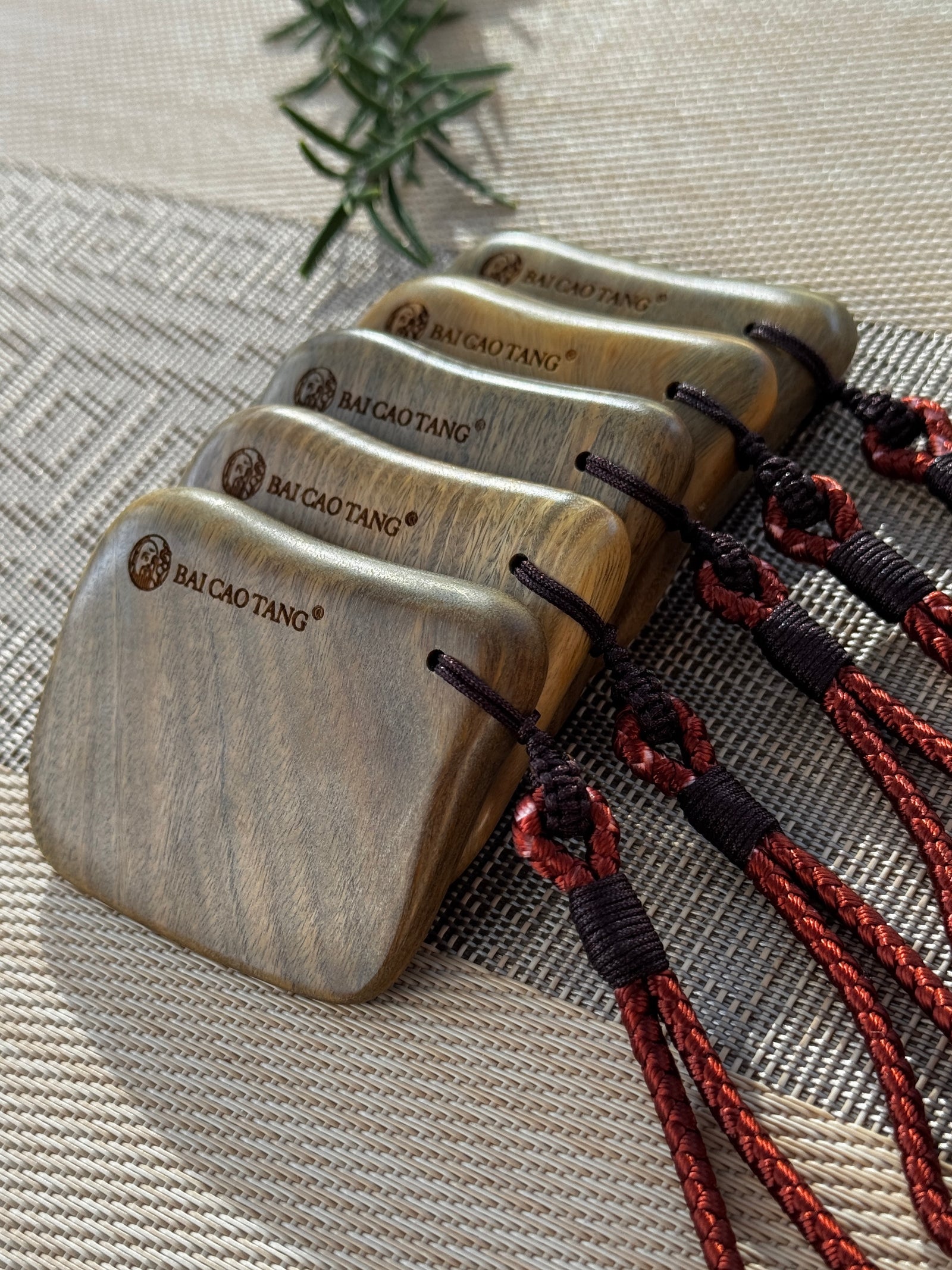
A facial tool earns its place through control. The Bai Cao Tang Square Sandalwood Gua Sha Tool has a broad, flat working edge and a compact approximately 70 × 55 mm body that sits securely in the hand. It is carved from solid South American Green Sandalwood and hand-polished without lacquer or synthetic coating.

TEN MINUTES · ONE QUIET RITUAL
A broad edge for an unhurried glide
The warm wooden contact, natural grain and subtle aroma turn the routine into more than a timer. Unlike stone, the wood does not begin with a cold shock. Its value here is sensory and design-led: a stable grip, a broad gliding surface and a tactile object that encourages an unhurried pace.
Because the wood is natural and unlacquered, do not wash or soak it. Wipe away oil or serum promptly with a soft cloth and store it in a cool, dry place away from direct heat and sun.
BEGIN YOUR TEN-MINUTE FACIAL RITUALReal Bai Cao Tang product photograph. The product outline, logo and natural wood grain have not been redrawn.
MELBOURNE CLINIC ROOTS
Tradition translated with professional restraint
Bai Cao Tang Wellness grew alongside a Melbourne Traditional Chinese Medicine clinic. That background shapes the way we translate tradition for home use: the technique should be clear, the pressure should remain comfortable and the claims should stay proportionate to the evidence.
Our registered Chinese medicine practitioner brings clinical awareness to the education. The square board remains a general-wellness object for external self-massage—not a substitute for dermatology, dental care or individual treatment.
Frequently asked questions
Can I use facial gua sha every day?
Some people tolerate a light daily routine, but daily use is not automatically better. The 2025 study used five sessions per week. Start with two or three sessions, then increase only if the skin remains comfortable.
Should facial gua sha leave red marks?
Facial gua sha should not aim to create petechiae or bruising. Mild temporary warmth can occur, but strong redness, soreness or broken capillaries are signs to stop and reassess pressure and slip.
Do I need facial oil?
You need enough compatible skincare slip for the board to glide without tugging. This may be a facial oil, balm or suitable serum depending on your skin. Avoid experimenting over already irritated skin.
Can I use the board around the eyes?
Keep contact extremely light, remain on the orbital bone and avoid the eyelids. If your eyes or surrounding skin are irritated, swollen or recently treated, leave the area alone and seek appropriate advice.
References
- Ahn S-H, Hwang U-J, Han HS, et al. Comparative Effects of Facial Roller and Gua Sha Massage on Facial Contour, Muscle Tone, and Skin Elasticity: Randomized Controlled Trial. Journal of Cosmetic Dermatology. 2025;24(6):e70236. DOI.
- Miyaji A, Sugimori K, Hayashi N. Short- and long-term effects of using a facial massage roller on facial skin blood flow and vascular reactivity. Complementary Therapies in Medicine. 2018;41:271–276. PubMed.
- Nielsen A, Knoblauch NTM, Dobos GJ, Michalsen A, Kaptchuk TJ. The effect of Gua Sha treatment on the microcirculation of surface tissue: a pilot study in healthy subjects. Explore. 2007;3(5):456–466. PubMed.
- American Academy of Dermatology. Face washing 101. Accessed 25 July 2026. Official guidance.
General information only. Facial gua sha research remains limited; the 2025 trial was small, had no non-massage control and did not test the Bai Cao Tang tool or permanent effects. Avoid broken, inflamed or recently treated skin and seek professional advice for persistent swelling, pain, rash, bruising or other concerning changes.